Meritorious CodeCrafters designed and deployed a production-grade, multi-agent AI system for a global enterprise in the Human Capital Management (HCM) and payroll sector. The system automates HR workflows - meeting scheduling, payroll artifact generation, documentation translation, and meeting summarization - through a network of specialized AI agents coordinated by a central supervisor.
Every action runs through governed, auditable tools rather than uncontrolled model access, so the platform stays compliant, traceable, and secure at enterprise scale. Meeting scheduling time dropped by more than 70%, HR administrative workload fell significantly, and documentation became instantly available across languages for globally distributed teams.
The client context
The client is a large multinational operating in human capital management and payroll. Their environment carries the constraints you'd expect at that scale: multi-country payroll compliance, large employee datasets, sensitive personal data (PII), and a multi-tenant enterprise architecture where dozens of internal systems must work together.
The organization wanted an internal AI automation layer - but on strict terms. No uncontrolled public model access. Full traceability of every decision. Tight integration with existing internal tools. And enforcement of enterprise identity and access management (IAM) throughout.
(Client and product names have been withheld under confidentiality. Details in this case study have been generalized so no proprietary or sensitive information is disclosed.)
The challenge
HR teams were spending significant time on repetitive, coordination-heavy tasks: scheduling meetings across time zones, generating payroll documents, translating internal documentation, and writing up meeting notes. These tasks were slow, error-prone, and difficult to scale across a global workforce.
A naive "connect an LLM to everything" approach was off the table. In a payroll and HR context, that creates unacceptable risk around data exposure, hallucinated calculations, and untraceable decisions.
The real problem was harder than automation alone: how do you get the flexibility of large language models while keeping enterprise-grade security, compliance, and auditability?
The constraints were explicit:
- No direct or uncontrolled access to public LLMs
- Complete traceability of every action the system takes
- Deep integration with internal HR, payroll, and documentation systems
- Support for high concurrency
- Enforcement of enterprise identity and access controls
The solution
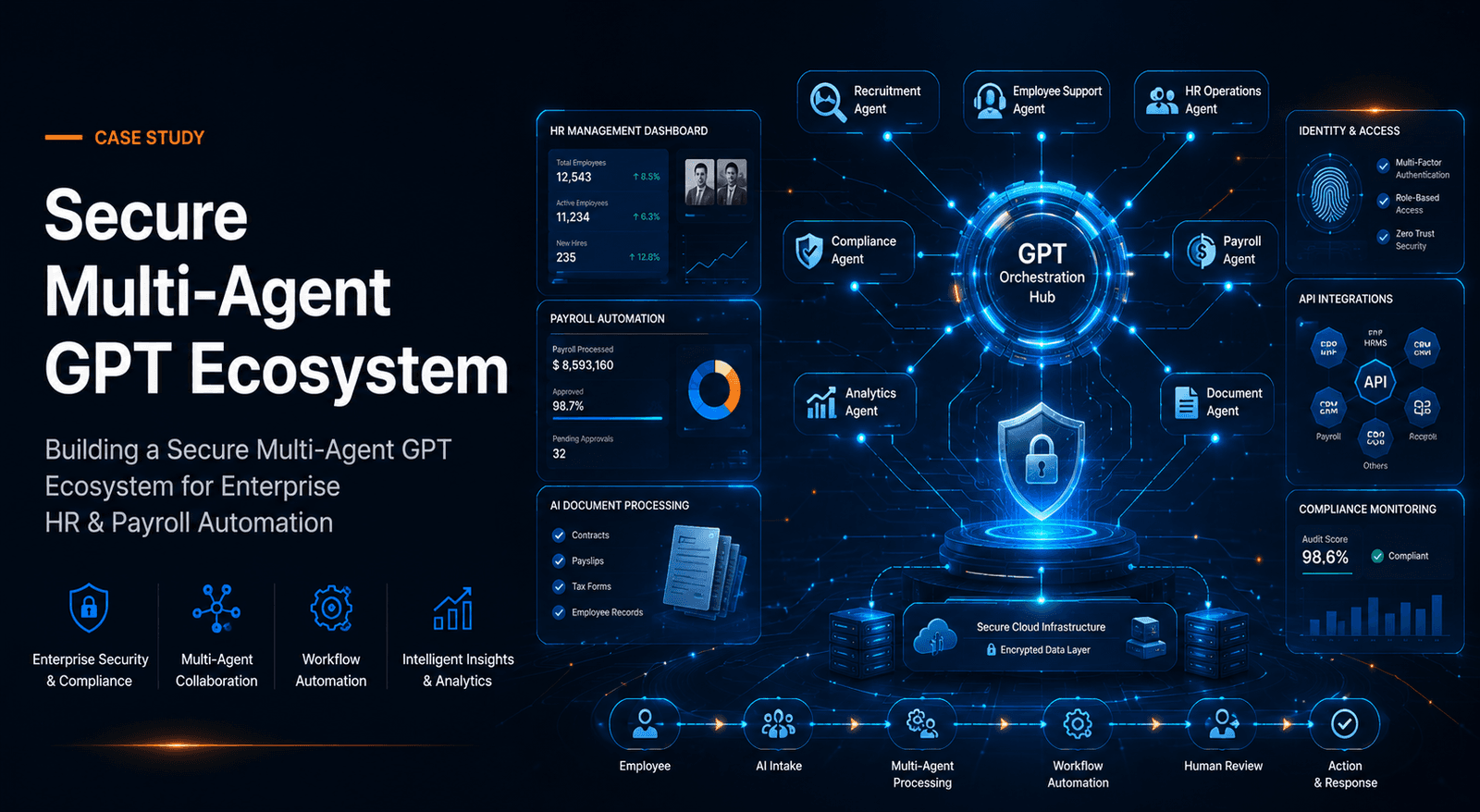
Meritorious CodeCrafters built a multi-agent AI ecosystem - a set of specialized AI agents, each responsible for one domain, coordinated by a central supervisor agent that routes work to the right place.
The guiding principle: the AI orchestrates; it does not compute sensitive logic on its own. Language models decide what needs to happen and in what order, while all sensitive operations - payroll math, calendar changes, data retrieval - run through governed, schema-validated tools with their own guardrails.
How the system is organized
A user request reaches a supervisor agent, which routes and coordinates. The supervisor delegates to four domain agents - meeting scheduling, translation, payroll document generation, and meeting summary. Each of those acts only through a governed tool layer of validated, auditable actions, which is what finally touches the internal HR, payroll and documentation systems.
Three architectural decisions made this work.
1. Deterministic agent workflows. Instead of letting agents improvise freely, work flows through a defined state machine with predictable execution, state passed explicitly between steps, and built-in retry and fallback handling. This makes behavior repeatable and debuggable - essential in a compliance-sensitive setting.
2. A governed tool protocol. Every capability the AI can use - checking a calendar, fetching salary components, saving a document - is exposed as a strictly defined tool with a validated contract. The model can only act through these tools, which gives strong observability and makes every action auditable.
3. Explicit agent-to-agent communication. The supervisor delegates to domain agents, and context is passed openly between them. There's no hidden state, which keeps the system transparent and each component independently testable and replaceable.
What we delivered
Meeting scheduling agent
Automates scheduling across enterprise calendars end to end: it identifies participants, checks availability through internal calendar tools, proposes an optimal slot, and confirms the booking. It handles the messy parts too - detecting conflicts, re-negotiating times automatically, and resolving multiple time zones.
Result: meeting scheduling time reduced by more than 70%.
Documentation translation agent
Translates internal documentation into any target language while preserving structure and formatting. The pipeline fetches a page, breaks it into token-aware chunks, translates with full context, keeps the original layout intact, and stores a properly versioned copy. Batch processing and idempotent updates mean it can run across an entire knowledge base without creating duplicates or drift.
Result: documentation became instantly available in multiple languages, unlocking self-service for globally distributed teams.
Meeting summary agent
Turns raw meeting transcripts into clean, structured output: key decisions, action items, owners, and deadlines. Output is validated against a defined schema and normalized in post-processing, so summaries are consistent and machine-readable - not free-form text that varies every time.
Payroll document generation agent
Generates payroll artifacts by orchestrating internal HR tools. Given an employee reference, it fetches salary components, applies the correct deductions and tax rules, produces a structured payslip, then stores and notifies.
The critical design choice here: the AI never does the payroll math. Country-specific compliance rules and tax logic run in dedicated, tested tools. The model only coordinates the sequence. This gives a zero-hallucination tolerance where it matters most - the numbers on someone's payslip.
Results and impact
Beyond the numbers, the platform gave the organization something harder to quantify: a way to adopt modern AI capabilities without loosening its security or compliance posture.
Security and compliance by design
Security wasn't bolted on afterward - it shaped the architecture:
- The AI never touches the database directly; every operation goes through a validated tool.
- Sensitive personal data is masked before it ever reaches a prompt.
- Data is encrypted at rest using managed cloud key services.
- Access is enforced with role-based controls and enterprise IAM.
- Every tool invocation is logged, and full execution traces can be replayed for audit.
The result is a system where you can answer "what did the AI do, and why?" for any action, at any time.
Technology stack
The platform is built to scale horizontally: agent services are stateless, so capacity grows by adding instances, with async tool execution and per-agent rate limiting keeping performance stable under high concurrency.
What we learned
- Orchestration should be deterministic. Predictable, state-driven workflows are what make agentic AI trustworthy in production.
- Let the model orchestrate, not compute. Sensitive logic - especially payroll and compliance - belongs in tested tools, not in the model.
- Governed tools transform observability. Strict tool contracts make every action visible, testable, and auditable.
- Stateless design simplifies scaling. Keeping agents stateless made horizontal scaling straightforward.
- Schema validation reduces hallucination risk. Enforcing structured output keeps results reliable and machine-readable.
Where this goes next
The architecture is modular by design, so it grows without rework. Natural extensions include smarter scheduling that learns from patterns over time, a searchable AI-ready knowledge base, shared memory across agents, stronger isolation between tenants, and a dedicated agent that validates compliance in real time.